Every animal we see today is part of a long evolutionary chain, connected to ancestors that walked, swam, or flew millions of years ago. Some changes are dramatic, turning towering beasts into smaller forms, while others are subtle but still recognizable. Exploring these lineages lets us see how nature transformed prehistoric giants into the familiar species around us.
Horseshoe Crab – Euproops

Carboniferous horseshoe crabs like Euproops had brains and body plans strikingly similar to today’s species. A 310-million-year-old fossil even preserves a central nervous system matching modern layouts. Sometimes evolution says “don’t fix what works.”
Rhinoceros – Woolly Rhinoceros

Coelodonta antiquitatis wore a shaggy coat and grazed steppe-tundra, swinging a huge keratin horn across glacial winds. Modern rhinos kept the massive build and herbivore engine but shifted to warmer savannas and forests. The family’s durability contrasts with the woolly rhino’s Ice Age end.
Anaconda – Titanoboa

South America’s titan snake reached over 12–13 meters, dwarfing today’s largest boas and anacondas. Fossils from tropical coal mines point to greenhouse climates that could sustain such giants. Modern constrictors inherited the stealth and ambush plan at a more manageable scale.
Sloth – Megatherium

Tree-dwelling sloths descend from ground-thundering megatheriids. Megatherium stood elephant-tall and likely raised to browse high branches. As climates and ecosystems shifted, smaller, arboreal sloths survived where giants did not. The slow metabolism remained a winning trick.
Elephant – Woolly Mammoth

Mammoths and modern elephants are close cousins within Proboscidea. Mammoths evolved cold-weather features like spiral tusks and insulating coats, while living elephants thrived in warmer savannas and forests.
Domestic Dog – Ancient Wolves

Dogs were domesticated from ancient wolf populations, with genomic work showing contributions from multiple lineages. Over thousands of years, selective breeding re-tuned social behavior, body size, and skull shape. Yet the canine blueprint is still unmistakably wolf.
Penguin – Kumimanu

Paleocene New Zealand hosted Kumimanu, a giant penguin that may have weighed well over 150 kg. Early penguins diversified rapidly after dinosaurs disappeared, experimenting with body size and flipper anatomy. Modern penguins kept the torpedo shape but trimmed back the bulk.
Camel – Camelops

North America’s Pleistocene Camelops looked much like modern camels, roaming open country before camels went extinct in the New World. The living dromedary and Bactrian carried the torch in Africa and Asia. Camelids spread widely before glacial rhythms reshaped their map.
Otter – Siamogale

Siamogale, a giant Pliocene otter from China, had a bite suited to crushing hard prey. Modern otters still excel at cracking shells and fish with tool use and strong jaws. The semi-aquatic mustelid lifestyle is an old, flexible design.
Crocodile – Sarcosuchus

Cretaceous Sarcosuchus, the “super-croc,” grew far larger than today’s crocs and likely ambushed dinosaurs at river edges. Modern crocodilians kept the armor and ambush, downsizing to fit new foodwebs. The lineage shows long-term success with minimal redesign.
Andean Condor – Argentavis

The Andean condor glides Andean thermals with a 3-meter wingspan. Its Miocene teratorn cousin Argentavis likely spanned over 6 meters, among the largest known flying birds. Both rely on soaring efficiency and carrion, proving flight can scale impressively.
Moose – Cervalces

The Ice Age “stag-moose” combined elk-like antlers with moose-like proportions in North America. Modern moose adapted to boreal wetlands with long legs and a prehensile upper lip. The cervid toolkit keeps finding new shapes for similar browsing jobs.
Bison – Steppe Bison

Pleistocene steppe bison ranged from Europe to Alaska and figure into the ancestry and hybrid history of living bison. Ancient DNA and fossils trace their spread with glacial corridors. Today’s bison are smaller but still grassland shapers.
Frog – Triadobatrachus

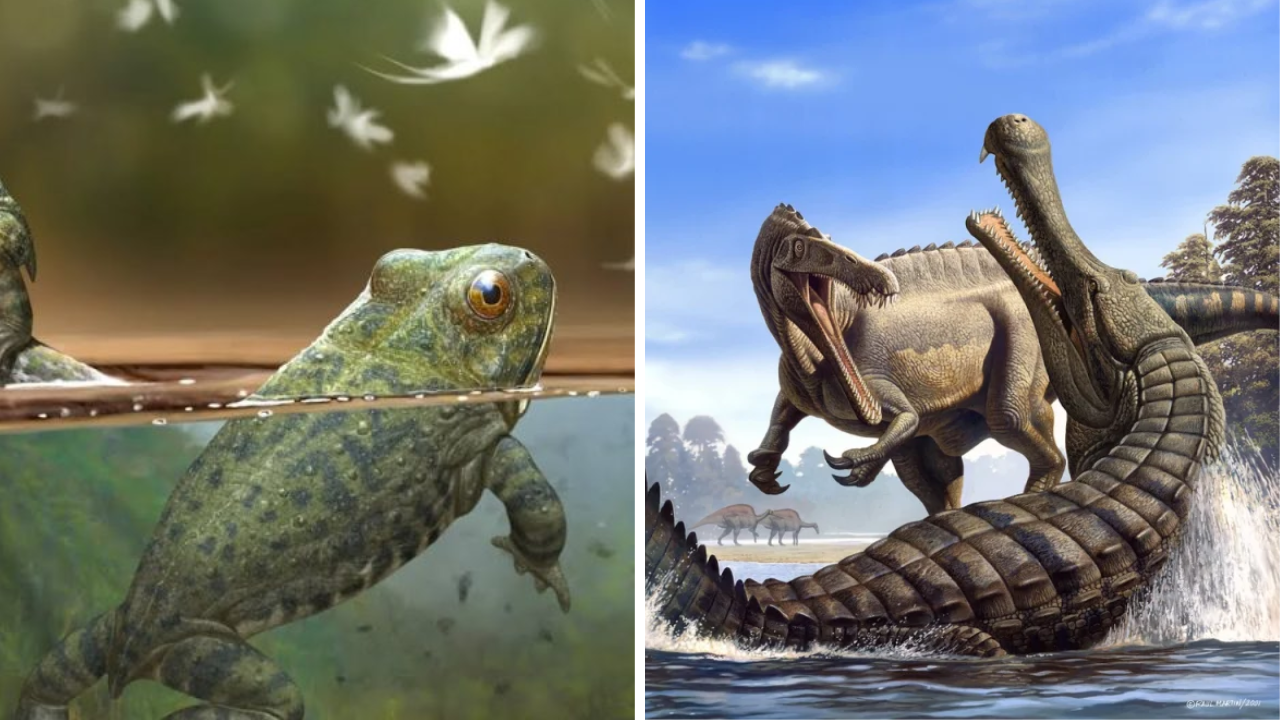
The squat jumper you know as a frog evolved from proto-frogs like Triadobatrachus, which still had extra vertebrae and a longer body. Over time, the frog body plan compacted and specialized for powerful leaps. It’s a textbook case of functional streamlining.
Caiman – Purussaurus

Today’s caimans are river ambushers, but their Miocene relative Purussaurus was a 10-meter super-predator ruling Amazonian wetlands. Skull mechanics and bite estimates suggest it crushed turtles and even proboscideans that strayed to water. A croc scaled up to bus length, vanishing with changing rivers and climates.