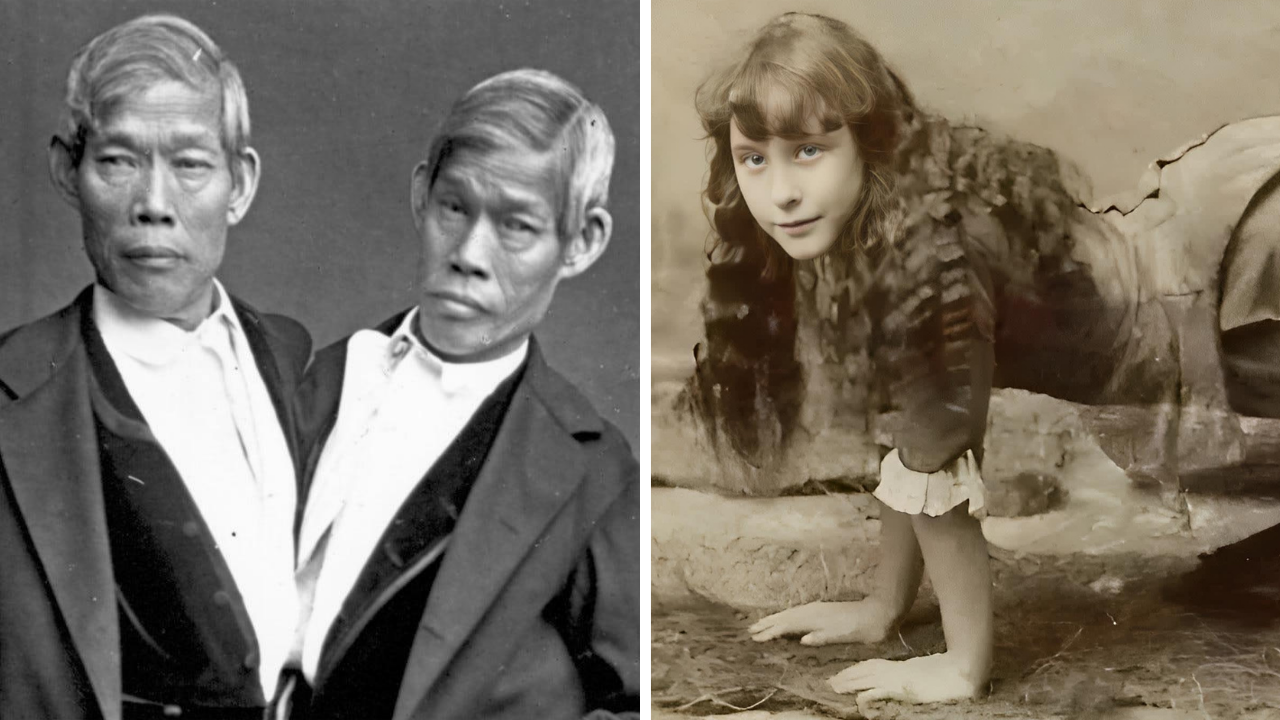
Long before television and the internet, circus sideshows drew huge crowds eager to see people advertised as the world’s greatest “human curiosities.” But behind the sensational posters were real people with real medical conditions, and lives that were often far more remarkable than the exaggerated stories printed on their tickets. Today, many historians view these performers not as spectacles, but as individuals who found a way to earn a living in a society that offered them very few opportunities.
They Were More Than Their Stage Names

Looking back, it’s easy to see that the posters often exaggerated, or completely invented, their stories. Behind every dramatic nickname was a real person trying to make a living in a world with very few opportunities for people who looked different. Today, many historians focus less on the spectacle and more on the remarkable resilience of the performers themselves.
Chang and Eng Bunker

The world’s most famous conjoined twins inspired the term “Siamese twins.” They toured internationally before settling down, marrying two sisters, and raising large families.
Myrtle Corbin, the Four-Legged Girl

Born with a rare condition that gave her two partially developed extra legs, Myrtle Corbin became one of the highest-paid performers of the nineteenth century before retiring to raise a family.
The Bearded Ladies

Bearded ladies became some of the biggest attractions in circus history. While audiences focused on their facial hair, many performers became successful businesswomen in their own right.
Schlitzie

Schlitzie became one of the most recognizable sideshow performers after appearing in the 1932 film Freaks. Despite decades of fame, much of Schlitzie’s early life remains a mystery.
Frances O’Connor, the Armless Wonder

Without arms, Frances O’Connor learned to perform nearly every daily activity with her feet, astonishing audiences with her skill rather than simply her appearance.
Prince Randian

Born without arms or legs, Prince Randian amazed audiences by writing, shaving, rolling cigarettes, and completing everyday tasks completely independently.
Lionel the Lion Faced Man

Stephan Bibrowski’s body was covered with long hair, leading audiences to believe he was part lion. Away from the stage, he was known as a gentle, educated man.
Joseph Merrick

Known during his lifetime as the “Elephant Man,” Merrick briefly appeared in exhibitions before eventually finding safety and friendship away from the sideshow world. His story remains one of history’s most moving.
Maximo and Bartola

Promoters falsely claimed these two performers belonged to a lost Aztec civilization. In reality, they were siblings from Central America born with microcephaly.
The Hilton Sisters

Conjoined twins Daisy and Violet Hilton became international celebrities through vaudeville and circus performances before later appearing in films and stage productions.
Ella Harper, the Camel Girl

Ella Harper walked on all fours because of a congenital condition affecting her knees. Promoters called her the “Camel Girl,” but she eventually left show business hoping for a quieter life.
George Williams, the Turtle Boy

Although advertisements portrayed him as half turtle, George Williams was also a talented singer and musician whose stage skills impressed audiences as much as his appearance.
Samuel Parks, the Frog Boy

Born with severe brittle bone disease, Parks transformed himself into “The Frog Boy.” Despite constant physical challenges, performing allowed him to support his family for many years.
Grady Stiles, the Lobster Boy

Born with ectrodactyly, which gave his hands and feet a claw-like appearance, Stiles became one of the last famous American sideshow performers. His life later became notorious for reasons that extended far beyond the circus.
Annie Jones, the Bearded Lady
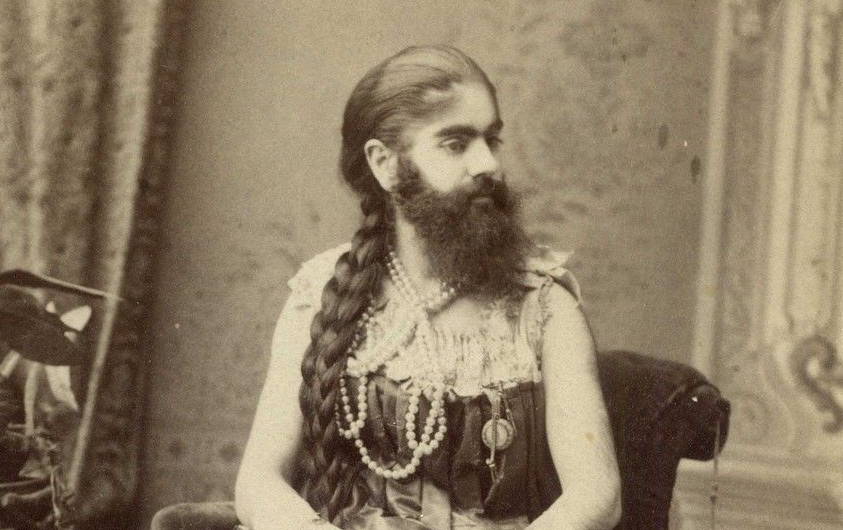
One of Barnum’s most celebrated performers, Annie Jones spent decades challenging assumptions about femininity while becoming one of the highest paid attractions in America.
General Tom Thumb

Charles Stratton became one of P. T. Barnum’s biggest stars after being reinvented as “General Tom Thumb.” Although his background and age were exaggerated for publicity, he became wealthy and internationally famous.
Krao, the “Missing Link”

Covered in hair because of a rare genetic condition, Krao was falsely promoted as proof of Darwin’s “missing link.” Offstage, she was well educated, spoke multiple languages, and even played the piano.
Jo Jo the Dog Faced Boy

Born with a rare condition that caused excessive facial hair growth, Fedor Jeftichew became famous as “Jo-Jo the Dog Faced Boy.” Promoters encouraged him to bark and growl on stage, even though he was intelligent and spoke several languages.