Long before online orders and delivery apps, the doorbell brought the milkman, the paperboy, a telegram, or a stranger with a sales case full of brushes. These 24 visits follow the people who once showed up at the door, using real photographs and advertisements from 1908 to 1980. See how many of them you remember from your own street.
Watching the milk wagon make its rounds

This stereograph from around 1925, titled “Delivering Milk to City Homes,” shows a milkman working his way down a residential street with a horse-drawn cart. Home milk delivery stayed common well into the 20th century, before household refrigerators made it easy to buy and store milk on demand. The wagon’s slow pace down the block was its own kind of clock for the neighborhood.
Getting your milk by dogsled instead of truck

Not every milk route ran on wheels. In Treadwell, Alaska, on May 24, 1911, photographer John Nathan Cobb captured milkman Joe Kendler delivering milk with his own dogteam. The far north still expected fresh milk at the door, and a team of dogs did the job a horse or a truck couldn’t.
Buying a treat from the Good Humor man

Good Humor got its start in Youngstown, Ohio, in the early 1920s, and by the 1950s the company ran up to 2,000 trucks across the country. Marjory Collins photographed young Ann Atkins buying an ice cream from the Good Humor man in Greenbelt, Maryland, in the spring of 1942, calling him a daily visitor to the neighborhood. The chime out front meant it was time to go find a nickel.
Chasing the ice cream wagon before there were trucks

Ice cream was a popular treat even before electric refrigeration made it easy to keep. This horse-drawn ice cream delivery wagon, photographed around 1880 and held by Seattle’s Museum of History and Industry, shows just how far back the ritual of a wagon bringing dessert to the door really goes. Decades before Good Humor trucks, a driver like this one covered the same ground.
Riding your route with a bag full of papers

A newspaper carrier bag slung over the shoulder was the uniform of the job. This photograph, taken February 6, 1940, shows a boy on a bicycle with a Toronto Star carrier bag making his rounds in Whitby, Ontario. Rain or shine, the papers had to be on the porch before anyone sat down to breakfast.
Signing your first paper route license

Taking on a paper route meant paperwork of its own. This is a real 1970 carrier license for a Reporter-Dispatch route in Scarsdale, New York, signed by a junior high school principal. A license like this one, kept for decades, was often a kid’s first real job on record.
Handing the mail straight to the customer

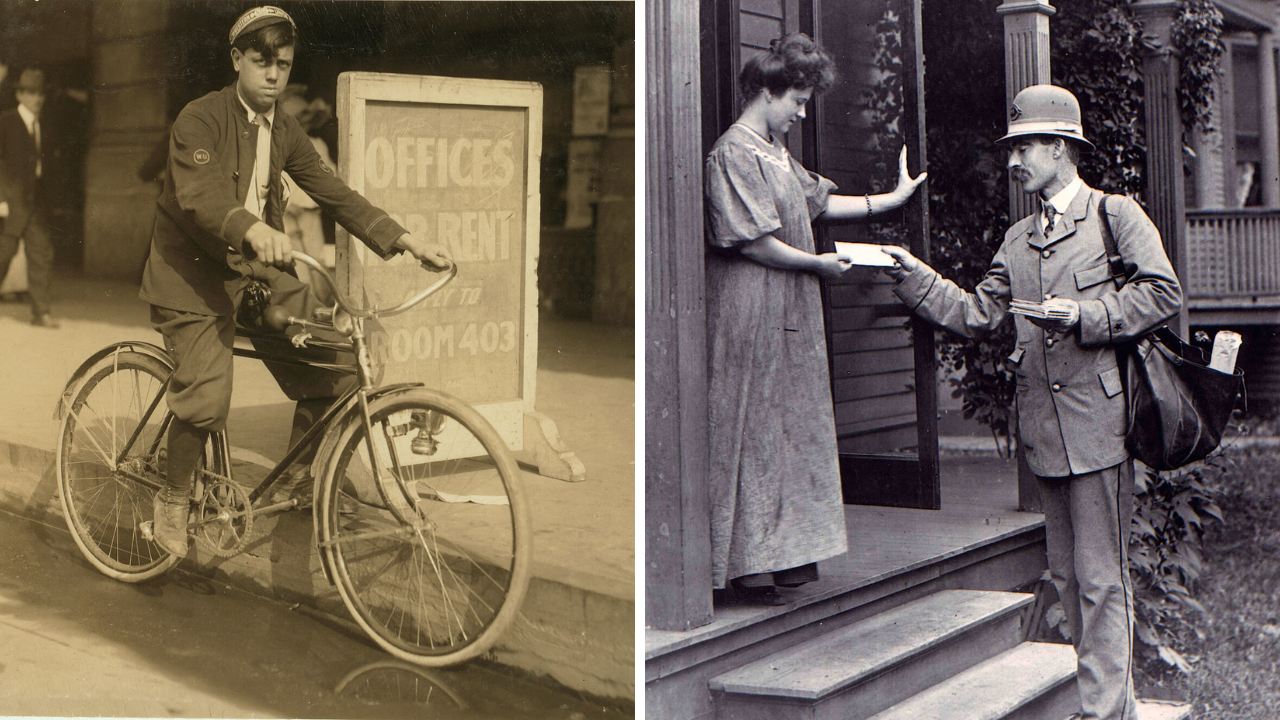
Before cluster mailboxes, a letter carrier often handed mail directly to whoever answered the door. This photo from the Smithsonian’s postal history collection shows an unidentified city letter carrier delivering mail to a woman along his route. A knock from the mailman could mean a bill, a birthday card, or news from someone far away.
Making the rounds on a mail bicycle

Some letter carriers covered their routes faster on two wheels. The Smithsonian’s postal history collection notes that carriers who chose bicycles could speed up their travel time considerably, and this photo catches one pausing along his daily rounds. A bicycle bell often announced the mail before the carrier even reached the gate.
Watching the postmen buzz by on scooters

Between 1911 and 1917, Washington, D.C. photographers Harris & Ewing captured postmen setting out from the post office on motor scooters instead of on foot. It was an early attempt to get mail delivered faster across a growing city. A fleet of scooters lined up outside the post office made for an unusual morning sight.
Spotting the mail truck parked on a snowy street

This Twin Coach postal van, photographed around 1953 and now in the Smithsonian’s collection, shows the right-hand-drive design that let a letter carrier reach curbside mailboxes without leaving the driver’s seat. A van like this one parked mid-route was as familiar a sight on a winter street as the carrier himself.
Watching the Western Union messenger leave the office

Before phone calls were routine, a telegram was often the fastest way to send urgent news, and a messenger boy carried it the rest of the way. Lewis Hine photographed one stepping out of the Western Union office in Cincinnati in 1908. A messenger arriving unannounced at the door could mean good news or bad, and everyone braced a little before opening the envelope.
Watching the telegram boy pedal through town

Hine photographed this messenger boy on his bicycle in New Orleans in November 1913, noting that telegraph companies were working to keep young messengers out of the city’s rougher districts. A bicycle let a messenger cover a wide territory quickly, weaving between deliveries all across town.
Delivering the telegram in person

In Houston in 1913, Hine photographed eleven-year-old Western Union messenger J.T. Marshall, who had been on the job for five months. Messenger work put boys like Marshall on doorsteps across the city every single day. A telegram meant someone, somewhere, needed you to know something right away.
Climbing the pole to fix the phone line

Keeping a rural telephone line running took someone willing to climb. This photo from the Gerald W. Williams Collection shows a Civilian Conservation Corps telephone repairman at work near Davis in West Virginia’s Monongahela National Forest. When the line went dead, everyone on it waited for a repairman like this one to show up and set it right.
Reading the meter outside your house

Long before smart meters sent readings automatically, someone from the utility company walked the block to check every house by hand. This 1980 photo from the Columbus Metropolitan Library’s collection shows a Division of Water employee reading a meter on the outside wall of a home in Columbus, Ohio. Most families never learned the reader’s name, but they knew the sound of that clipboard.
Answering the door for trick-or-treaters

Halloween brought its own kind of doorstep visitor. This newspaper photo, published in the Beaumont Daily Gazette on October 26, 1950, shows a costumed child and a woman greeting each other at the door with a dog looking on. A porch light left on was the signal that this house was ready for visitors.
Getting a house call from the company doctor

In August 1946, a federal survey of coal-mining communities photographed Dr. R.V. Tokar making his rounds for the U.S. Coal and Coke Company in Gary, West Virginia. The doctor had to leave his car at the foot of a hill and walk the last quarter mile to reach this patient. A doctor who came to you, bag in hand, was simply how illness got treated in towns without a hospital nearby.
Checking on the baby he delivered

Russell Lee photographed company doctor Pierce Martin stopping by in September 1946 to check on a baby he had delivered, at the Kentucky Straight Creek Coal Company in Kentucky. A follow-up visit like this one was as much a part of the job as the delivery itself.
Weighing the newest baby on the block

Registered nurse Hazel Jamison made her own rounds through the same 1946 survey, weighing the baby of miner Aubrey Cook’s family at their home near Kopperston, West Virginia. Her uniform carries a patch reading “Nursing, Koppers Coal Service,” marking her as company staff rather than a hospital nurse. A visiting nurse like Jamison tracked a family’s health one home at a time.
Letting the vacuum salesman make his pitch

A door-to-door demonstration was how many families ended up with their first vacuum cleaner. This photograph shows a General Electric salesman making his case to a skeptical customer, her arms crossed as he shows off the machine in her own living room. A demonstration on your own carpet was hard to say no to.
Welcoming your Avon Representative when she calls

“You open your door to Beauty,” read this 1953 Avon Cosmetics advertisement, showing a representative knocking with her sample case in hand. Avon’s founder, David H. McConnell, started out selling books door-to-door before switching to perfume in 1886, and the company built its entire business around representatives who called on customers at home. If no Avon office was listed in the phone book, the ad even gave a number to call for one.
Opening the door to the Fuller Brush Man

This Fuller Brush catalog cover calls its salesman “America’s Most Famous Visitor,” selling brushes for health, beauty, and home right from a sample case. Alfred Fuller founded the company in 1906, and its traveling salesmen became so familiar that the phrase “Fuller Brush Man” turned into a stand-in for any door-to-door salesman. One knock usually meant a full pitch before anyone got a word in.