
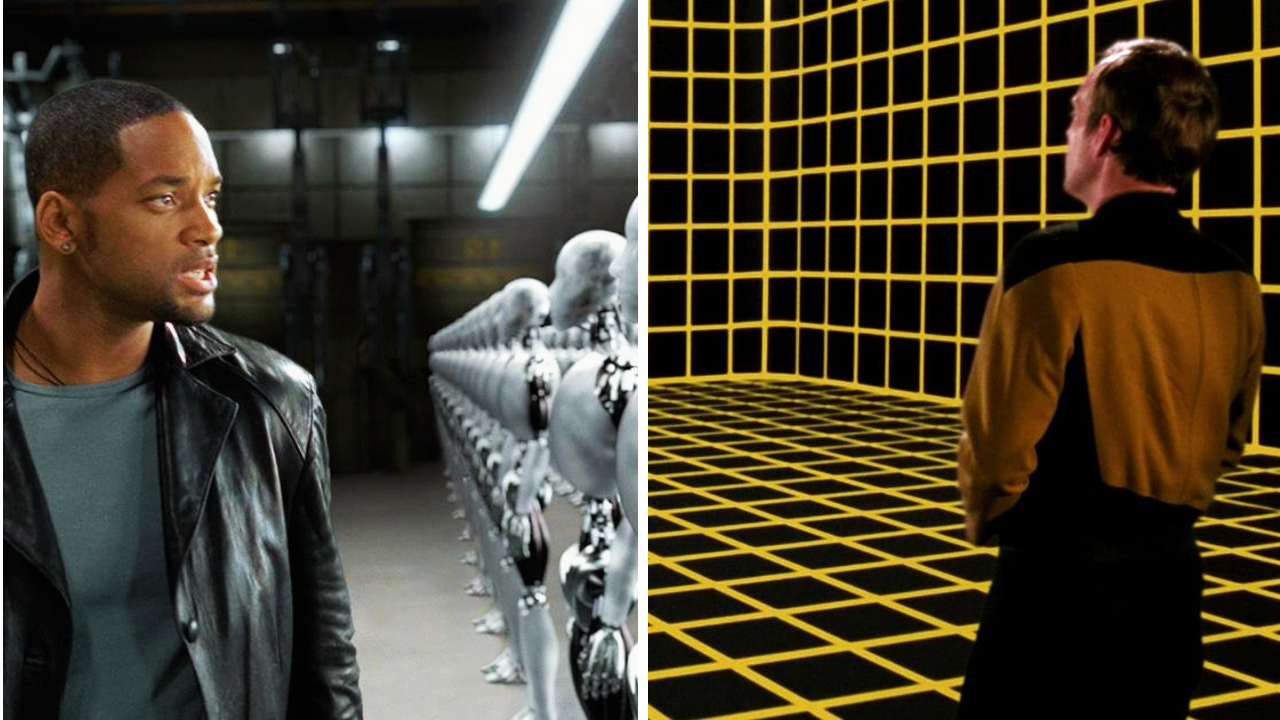
Science fiction has always imagined technologies and inventions that seemed impossible at the time, but some of those ideas eventually became part of everyday life. From video calls and smart devices to advances in robotics and space exploration, writers and filmmakers have made some surprisingly accurate guesses about the future. Here are 25 sci-fi predictions that actually came true.
Video Calls – Metropolis (1927)

Fritz Lang’s silent sci-fi classic featured a wall-mounted video telephone decades before FaceTime and Zoom. The idea of seeing someone while speaking to them seemed futuristic in 1927, but video calling is now an everyday feature of smartphones.
Tablets – 2001: A Space Odyssey (1968)

Stanley Kubrick’s astronauts used flat electronic devices called Newspads to watch broadcasts and read information. They looked remarkably similar to modern tablets, which became mainstream more than 40 years later.
Flip Phones – Star Trek (1966)

Captain Kirk’s handheld communicator became one of television’s most recognizable futuristic gadgets. Its flip-open design closely resembled mobile phones that appeared decades later, especially Motorola’s famous StarTAC.
Smartwatches – Dick Tracy (1946)

Dick Tracy’s two-way wrist radio first appeared in 1946, allowing the detective to communicate through a device strapped to his wrist. Modern smartwatches have taken the idea further with calls, messages, fitness tracking, and video communication.
Self-Driving Cars – Total Recall (1990)

Arnold Schwarzenegger’s character rides in a Johnny Cab, a robotic taxi that drives itself. Autonomous taxis now operate commercially in some cities, although today’s vehicles don’t have the cheerful robot driver sitting behind the wheel.
Wireless Earbuds – Fahrenheit 451 (1953)

Ray Bradbury described tiny wireless audio devices called Seashells that fit inside people’s ears. His fictional society listened to constant entertainment through them, much like today’s wireless earbuds and podcasts.
Personalized Advertising – Minority Report (2002)

Stores in Minority Report scan customers’ eyes and display advertisements tailored specifically to them. Modern online advertising uses browsing activity, shopping habits, and other data to deliver similarly personalized messages, although retinal scanning isn’t the standard method.
Artificial Intelligence Assistants – 2001: A Space Odyssey (1968)

HAL 9000 could understand spoken instructions, hold conversations, and control a spacecraft. Modern AI assistants can now respond to natural language and perform increasingly complex tasks, although HAL’s fictional level of autonomy remains beyond today’s systems.
Automatic Sliding Doors – Star Trek (1966)

The Enterprise featured doors that opened automatically as crew members approached. The technology already existed in early commercial forms, but Star Trek helped popularize the futuristic look that became familiar in airports, supermarkets, and office buildings.
Virtual Reality – Star Trek: The Next Generation (1987)

The Enterprise’s Holodeck allowed crew members to explore convincing computer-generated environments. Modern VR headsets provide immersive digital worlds for gaming, training, and education, though they still can’t recreate the Holodeck’s fully physical environments.
Gesture-Controlled Computers – Minority Report (2002)

Tom Cruise manipulates floating images with sweeping hand movements instead of a keyboard. Motion-sensing technology, including Microsoft’s Kinect and modern hand-tracking systems, has since made gesture-based computer control a reality.
Credit Cards – Looking Backward (1888)

Edward Bellamy’s futuristic novel imagined citizens using credit cards to obtain goods without exchanging physical money. His fictional cards worked differently from modern bank credit, but the resemblance to cashless shopping is striking.
Moon Landings – From the Earth to the Moon (1865)

Jules Verne imagined launching three men toward the Moon using a giant cannon in Florida. More than a century later, Apollo 11 launched three astronauts from Florida and successfully landed two of them on the lunar surface. The cannon was fictional, but several details were remarkably close.
Universal Translators – Star Trek (1967)

Star Trek introduced technology that allowed characters to communicate across language barriers almost instantly. Today’s AI translation apps and earbuds can translate conversations between supported human languages in near real time, although they’re nowhere near perfect.
Video Surveillance – Nineteen Eighty-Four (1949)

George Orwell imagined telescreens that watched citizens while broadcasting government messages. Modern CCTV networks, facial recognition, and digital monitoring have made widespread surveillance technologically possible, although their use and legal restrictions vary enormously.
Robotic Vacuum Cleaners – The Jetsons (1962)

The Jetsons imagined a future where household robots handled tedious chores. While Rosie was far more capable than today’s machines, robotic vacuum cleaners have made one part of that vision commonplace in real homes.
Voice-Controlled Homes – Demon Seed (1977)

Demon Seed featured a house controlled by an advanced computer that could operate doors, security systems, and household equipment. Modern smart homes can manage lights, thermostats, locks, and appliances through voice commands, fortunately without the movie’s sinister intentions.
Space Tourism – 2001: A Space Odyssey (1968)

The film imagined commercial space travel, complete with airline-style service and comfortable passenger cabins. Private companies have since carried paying customers into space, although orbital tourism remains far more expensive and difficult than the movie suggested.
Video Conferencing at Work – The Jetsons (1962)

George Jetson regularly communicated with his boss through a video screen. Decades later, workplace video meetings became routine, particularly as remote work expanded. Even the annoyance of having your boss appear on a screen turned out to be accurate.
Augmented Reality Glasses – Dragon Ball Z (1989)

Dragon Ball Z’s Scouters displayed information about people directly over the wearer’s field of vision. Modern augmented-reality glasses and headsets can overlay navigation, notifications, and digital information onto the real world, although they can’t measure someone’s fighting power.
Digital Billboards – Blade Runner (1982)

Ridley Scott’s futuristic Los Angeles was filled with enormous electronic advertisements illuminating the city. Today’s digital billboards, particularly in places like Times Square and Tokyo’s Shinjuku district, look remarkably similar to the movie’s urban landscape.
Robots Working Alongside Humans – I, Robot (2004)

I, Robot imagined machines performing everyday jobs and assisting humans. Industrial robots now handle manufacturing, warehouse sorting, and other repetitive tasks, while newer humanoid robots are being tested in workplaces. The movie’s fully independent household robots remain fictional.
Lab-Grown Meat – The Space Merchants (1952)

Frederik Pohl and C. M. Kornbluth imagined a giant mass of cultivated chicken tissue supplying meat to consumers. Scientists produced the first publicly demonstrated cultivated beef burger in 2013, and some lab-grown meat products have since received regulatory approval.
4D Cinemas – Brave New World (1932)

Aldous Huxley’s novel featured the Feelies, movies that stimulated physical sensations as well as sight and sound. Modern 4D cinemas use moving seats, water sprays, wind, and other effects to make audiences physically experience parts of a film.
Satellite Communications – Arthur C. Clarke’s Vision (1945)

Science-fiction author Arthur C. Clarke proposed using satellites in geostationary orbit to relay communications around the planet. His 1945 article outlined a system remarkably similar to the networks later used for television broadcasts and global telecommunications.







