Some of the friendliest faces in American kitchens, bathrooms and grocery aisles never existed at all. From Betty Crocker to Mr. Whipple, here are 26 made-up people that companies invented to sell everything from cereal to paper towels.
The Quaker Oats Man

The Quaker Mill Company registered its smiling man in Quaker clothing in 1877, and he became the first trademark registered for a breakfast cereal. Quaker has long said he does not portray any real person. In this 1977 ad, he reads a story to a little girl to sell Quaker cookie mixes.
Sunny Jim

Force cereal introduced Sunny Jim in 1902, a grumpy character called Jim Dumps who turned cheerful after a bowl of Force. The jingles made him so popular that “Sunny Jim” became an everyday nickname. This poster from 1903 shows him in his top hat and red coat.
Buster Brown

Buster Brown began as a comic strip character in 1902, and a St. Louis footwear company bought the rights to his name at the 1904 World’s Fair. He and his dog, Tige, were the face of the brand for decades. This early store display shows the pair with the company’s Blue Ribbon line.
The Campbell Kids

Illustrator Grace Drayton drew the round-faced Campbell Kids in 1904, and they have been selling soup ever since. Over the years, they have appeared on soup labels, ads and even dolls. In this ad, one of them holds a can of Chicken & Stars under the line “Twinkle, Twinkle Bigger Stars!”
The Morton Salt Girl

The girl with the umbrella first appeared in 1914 with the slogan “When it rains it pours,” a nod to salt that kept flowing even in damp weather. Her look was updated in 1921, 1933, 1941, 1956 and 1968. This version from the 1950s shows her in a yellow dress, still spilling salt behind her.
Mr. Peanut

A schoolboy named Antonio Gentile sketched the first Mr. Peanut in 1916 for a Planters contest, and a commercial artist later polished the design, adding the top hat and monocle. This comic book from 1956 told “The Personal Story of Mr. Peanut” for the company’s 50th anniversary.
Betty Crocker

Washburn-Crosby, the company behind Gold Medal Flour, created Betty Crocker in 1921 to answer letters from home bakers. Her face first appeared in a 1936 portrait and has been updated several times since. In 1945, Fortune magazine named her the second most popular woman in America after Eleanor Roosevelt.
The Jolly Green Giant

The Minnesota Valley Canning Company introduced its giant in 1928, and an ad agency later made him green and smiling. The character became so famous that the company renamed itself Green Giant in 1950. In this 1954 ad, he stands beside a huge can of sweet peas.
Little Miss Sunbeam

Artist Ellen Segner created Little Miss Sunbeam in 1942, a curly-haired girl with a blue bow and a slice of bread in her hand. She became the face of Sunbeam bread across the country. This 1953 ad has her peeking around a door to ask, “May I come to Dinner?”
Miss Chiquita

United Fruit Company introduced Miss Chiquita in 1944, a dancing banana with a fruit hat and a jingle that told shoppers when to eat bananas and how to store them. In 1987, the company turned her into a woman. This 1950s poster shows her leading a row of singing bananas.
Speedy Alka-Seltzer

Speedy first appeared in 1951, a small boy whose body was an Alka-Seltzer tablet. He starred in more than 200 TV commercials between 1954 and 1964. This ad shows him standing on a tower of Alka-Seltzer boxes, waving his wand.
The Man in the Hathaway Shirt

Ad man David Ogilvy introduced this character in 1951 to sell C.F. Hathaway shirts. The model wore a black eye patch that Ogilvy picked up at a pharmacy for $1.50, and the mystery around it made the shirts famous. The campaign ran for years in magazines like this one.
Mr. Clean

Procter & Gamble introduced Mr. Clean in 1958, with his bald head, crossed arms and gold earring. His official backstory says he was a U.S. Navy sailor from Pensacola, Florida. A 1962 contest even gave him a first name: Veritably.
Juan Valdez

Colombia’s coffee growers introduced Juan Valdez in 1958 to show the care behind their beans. He was always played by real actors, while the farmer himself was invented for the ads, along with his donkey, Conchita. Here he enjoys a cup of the coffee he made famous.
Ronald McDonald

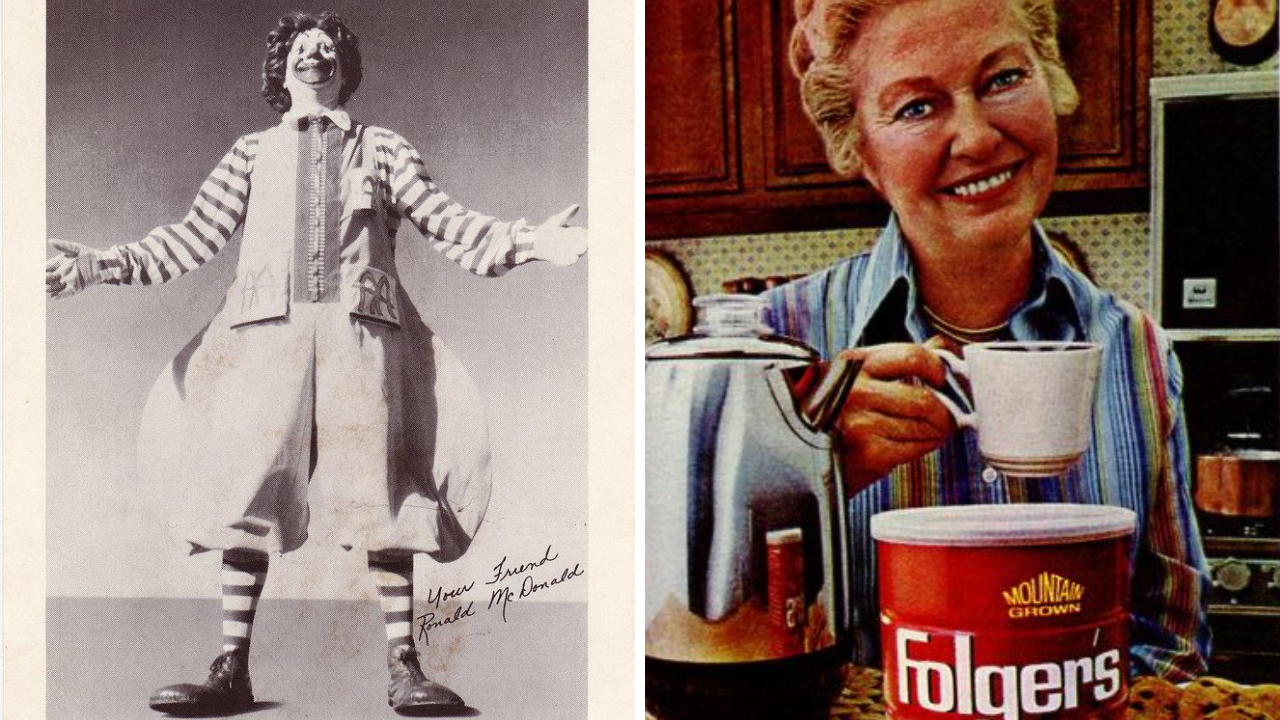
Ronald McDonald was created in 1963 for a McDonald’s franchise in Washington, D.C., where local TV personality Willard Scott played him first. The clown went national in 1966. This signed photo card comes from the Ronald McDonald Club in 1965.
Cap’n Crunch

Quaker introduced Cap’n Crunch in 1963, and his full name is Cap’n Horatio Magellan Crunch. This box is one of the first ever made, with the captain waving his sword on the front. In 2013, fans noticed that the three stripes on his sleeve make him a commander, not a captain.
Mrs. Olson

Folgers introduced Mrs. Olson in 1965, a Swedish neighbor who showed up just in time to fix a couple’s bad coffee. Actress Virginia Christine played her from 1965 to 1986. This 1978 ad shows her twice, serving two kinds of Folgers in her kitchen.
The Pillsbury Doughboy

Pillsbury introduced Poppin’ Fresh, better known as the Doughboy, in 1965. The little chef made of dough giggles whenever someone pokes his belly, a gag that is still part of the ads today. In this still from a 1972 commercial for Poppin’ Fresh Danish, he stands on a breakfast table.
Madge the Manicurist

Madge first told her clients “You’re soaking in it!” in 1966, revealing that their fingers were sitting in Palmolive dish soap. Actress Jan Miner played her in commercials until 1992. In this 1975 ad, Madge wears her name on her uniform.
Mother Nature

Chiffon margarine made up a cheerful Mother Nature in the 1970s, who smiled until she learned that the spread she had praised was really Chiffon. Her angry line “It’s not nice to fool Mother Nature!” became a catchphrase. In this photo, she holds a box of Chiffon with daisies in her hair.
Mikey From Life Cereal

Life cereal’s 1972 commercial showed two brothers making their picky little brother, Mikey, try the cereal first. When he ate it all, they shouted, “He likes it! Hey, Mikey!” The campaign ran until 1986, one of the longest runs in TV advertising.
The Brawny Man

The Brawny Man showed up in the 1970s, a lumberjack in a plaid shirt who promised a tough paper towel. His look has changed over the years, though he has kept the plaid. This roll from 1985 shows the mustached version on the package.
Mr. Goodwrench

General Motors created Mr. Goodwrench in the 1970s to promote its dealers’ service departments. The friendly mechanic became so well known that the name later appeared on Dale Earnhardt’s No. 3 race car. This 1978 drawing shows him holding a “Participating Dealer” sign.
Warby Parker

The eyewear company founded in 2010 is not named after a real person. Its founders took the name from two characters, Warby Pepper and Zagg Parker, in the private journals of writer Jack Kerouac, shown here on the Columbia University football team in 1940.
Mr. Whipple

Mr. Whipple, the fussy grocer who begged shoppers “Please don’t squeeze the Charmin,” first appeared in 1964. He starred in more than 500 commercials over 20 years. One survey ranked him the third best-known American, behind Richard Nixon and Billy Graham.
Josephine the Plumber

Comet cleanser introduced Josephine the Plumber in 1963, a handy expert who showed customers how to scrub away stains. Former child star Jane Withers played her for more than 10 years. In this early ’60s ad, she holds a can of Comet and points to it.