NASA has captured some of the most unforgettable images ever taken, from the first footsteps on the Moon to distant planets billions of miles away. Some marked major milestones in space exploration, while others simply revealed the beauty of places few people will ever see. Together, they tell the story of decades of discovery, exploration, and technological achievement. Here are some of the greatest NASA photographs ever captured.
Gemini 10 Time Lapse

This photo combines multiple moments from the launch of NASA’s Gemini 10 mission into a single image. The repeated positions of the Titan II rocket show its climb into the sky, creating a striking sense of speed and motion. It’s a different way of looking at a launch, capturing the excitement of liftoff in one frame.
Apollo 11 Bootprint

Few images capture the Moon landing as simply as this one. The clear footprint left in the lunar dust became a lasting symbol of humanity’s first steps on another world during the Apollo 11 mission. More than 50 years later, it’s still one of the most recognizable photographs in space exploration.
Hubble Telescope

Floating high above Earth, the Hubble Space Telescope looks almost weightless against the darkness of space. The curve of the planet and the blanket of clouds below provide a stunning backdrop for one of NASA’s most important observatories.
Buzz Aldrin

This photo captures one of the most famous moments of the Apollo 11 mission. An astronaut, the American flag, and the stark lunar landscape all come together in a single frame.
Storm in Jupiter

This image captures Jupiter’s swirling clouds and the Great Red Spot, an ancient storm that has been churning through the planet’s atmosphere for centuries. The storm is so large that Earth could fit inside it. Its bands of cream, gold, and orange make Jupiter one of the most recognizable worlds in the solar system.
Apollo 11 Liftoff

This photograph captures the moment the Apollo 11 mission lifted off from Kennedy Space Center on July 16, 1969. The Saturn V rocket rises through a cloud of fire and smoke as it begins the journey that would carry Neil Armstrong, Buzz Aldrin, and Michael Collins toward the Moon.
The Mercury Seven

This portrait shows NASA’s original Mercury Seven astronauts, the first group selected for America’s human spaceflight program in 1959. They helped pave the way for the Mercury, Gemini, and Apollo missions that followed. More than a team photo, it’s a picture of the men who launched the United States into the Space Age.
Hubble Ultra Deep Field

What looks like a field of stars is actually packed with thousands of galaxies, each containing billions of stars. The Hubble Ultra Deep Field was created by pointing the Hubble Space Telescope at one tiny patch of sky for days to capture some of the most distant galaxies ever observed. The image offered one of humanity’s deepest looks into the universe.
Saturn Eclipse

Cassini captured this remarkable view of Saturn while the planet blocked the Sun from view. The eclipse reveals the planet’s rings in stunning detail, along with a faint halo of sunlight around the edges. It’s one of the most iconic images ever returned from the Cassini mission.
International Space Station

The International Space Station passes over Earth with its solar panels glowing in the sunlight. Stretching nearly the length of a football field, it’s the largest structure ever assembled in orbit.
Gemini VI Spacecraft

A Gemini spacecraft floats above Earth with the planet’s blue horizon stretching across the background. NASA’s Gemini missions helped prove astronauts could perform the docking maneuvers, spacewalks, and extended flights needed before attempting a trip to the Moon. Images like this captured an important step on the road to Apollo.
Pluto

This close-up of Pluto was captured by NASA’s New Horizons spacecraft during its historic 2015 flyby. Bright icy plains, dark regions, and rugged terrain revealed a world far more complex than scientists expected. For many people, it was the first time Pluto looked like a real place instead of a distant point of light.
HL-10 on the Lakebed

The HL-10 lifting body sits on the dry lakebed at Edwards Air Force Base as a B-52 flies overhead. NASA used the aircraft to study how future spacecraft could glide back to Earth and land like airplanes.
Ed White’s First Spacewalk

Ed White floats above Earth during America’s first spacewalk on the Gemini 4 mission in 1965. Using a handheld maneuvering gun, he spent about 20 minutes outside the spacecraft, becoming the first American to walk in space.
Space Shuttle Atlantis Docked with Mir

The Space Shuttle Atlantis approaches Russia’s Mir space station while orbiting high above Earth. The Shuttle-Mir program brought American astronauts aboard the station and marked a new era of cooperation in space after the Cold War. The missions also gave NASA valuable experience that helped pave the way for the International Space Station.
John Glenn Boards Friendship 7

John Glenn climbs into the Friendship 7 capsule before his Mercury-Atlas 6 mission in 1962. The flight made him the first American to orbit Earth, completing three trips around the planet. His success marked a major milestone in the early years of the Space Race.
Earthrise

Captured during the Apollo 8 mission, Earthrise shows our planet rising above the Moon’s horizon for the first time. The photograph gave people a completely new perspective, revealing Earth as a small blue world surrounded by the darkness of space.
Bruce McCandless II’s Untethered Spacewalk

Bruce McCandless II drifts above Earth during the first untethered spacewalk in 1984. Using NASA’s Manned Maneuvering Unit, he moved through space without being attached to the Space Shuttle. The image gives a real sense of just how vast space can feel.
The Blue Marble

Taken by the Apollo 17 crew in 1972, this image shows Earth almost fully illuminated from space. Africa, Antarctica, and sweeping cloud patterns are all visible in remarkable detail. It’s one of the most recognizable photographs ever taken of our planet.
Space Shuttle Discovery in Orbit

Space Shuttle Discovery orbits high above Earth with its payload bay doors open. The blue oceans and scattered clouds below provide a reminder of just how far the shuttle traveled above the planet. During its 39 missions, Discovery launched satellites, helped build the International Space Station, and carried the Hubble Space Telescope into orbit.
Viking 1’s First View of Mars
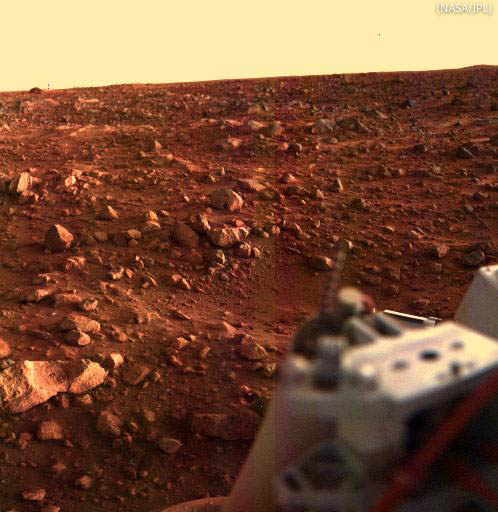
Viking 1 returned humanity’s first successful photographs from the surface of Mars in 1976. The rocky landscape stretched to the horizon, giving people their first real look at what it would be like to stand on the Red Planet. It was the beginning of a new chapter in Mars exploration.
Neil Armstrong with the X-15 Rocket Plane

Before becoming the first person to walk on the Moon, Neil Armstrong was one of NASA’s top test pilots. Here he stands beside the X-15, a rocket-powered aircraft that pushed the limits of speed and altitude during the early days of space research.
Global Color Mosaic of Triton

This global color mosaic reveals the icy surface of Triton, Neptune’s largest moon, in remarkable detail. Subtle shades of white, gray, and pale green highlight a landscape shaped by frozen plains, ridges, and unusual terrain.
Neptune in True Color

Lunar Rover

Driving across the Moon wasn’t something people imagined seeing in the early days of spaceflight. The Lunar Roving Vehicle let Apollo 17 astronauts cover miles of rugged terrain during their mission. It opened up parts of the lunar surface that would have been impossible to reach on foot.
Moon Craters

From orbit, the Moon looks covered in craters of every size. This Apollo 11 image highlights the rugged terrain the astronauts flew over before beginning their descent. Every impact tells part of the Moon’s long history.
Saturn, Its Rings, and Two Moons

Saturn’s rings stretch across the frame while two of its moons drift nearby. The image gives a good sense of the planet’s enormous size and the scale of its ring system.
Goodbye to Pluto

As New Horizons left Pluto behind, it looked back and captured this thin crescent glowing in the sunlight. The backlit view revealed layers of haze in Pluto’s atmosphere that hadn’t been seen before. It was a fitting farewell after humanity’s first close visit to the distant dwarf planet.
Sky Filled with Stars

At first glance, this looks like a city glowing at night. It’s actually a dense cluster of stars packed tightly together, with countless more fading into the background. The closer you look, the more stars seem to appear.