Nineteenth-century portraits have a reputation for serious faces, but not everyone kept a straight expression for the camera. These photographs bring together smiling children, playful friends, and public figures caught in unusually relaxed moments. Their expressions make a distant century feel unexpectedly close.
Two officers show a lighter side in 1847

Two American officers posed together in Veracruz during the Mexican-American War in 1847. Their expressions are strikingly relaxed for an early military daguerreotype. The image offers a glimpse of the people behind the uniforms, rather than another formal record of wartime service.
An Oslo gathering breaks the solemn-portrait rule

A daguerreotype made around 1850 shows a group of intellectuals gathered in Oslo, Norway. Instead of the perfectly rigid expressions associated with early photographs, the scene has a surprisingly easygoing feel. Group portraits like this required planning, which makes the livelier mood all the more memorable.
Isaac Wallace Baker deals himself into history

Around 1853, Isaac Wallace Baker posed for a playful ambrotype showing him at a card table. One player smiles toward the viewer while the other studies his hand. Long before family snapshots became commonplace, photographers were already finding ways to turn a portrait into a small story.
A boxer strikes an unexpected studio pose

An ambrotype dated to 1860 portrays an unidentified African American man adopting a boxer’s stance. His raised arms give the image movement and character that a conventional seated portrait might have missed. It is an early example of someone using the camera to present a personality, not simply a likeness.
Two children share a delighted moment

Two children face each other in a studio portrait, their hands meeting as one smiles broadly. Their neatly arranged clothing belongs to the formal world of nineteenth-century photography, but their interaction feels wonderfully unplanned. Whatever prompted the laughter, it survived in an image that still feels familiar.
A gentleman grins inside an ornate gold frame

This unidentified gentleman sits in formal dress, with a dark jacket and bow tie, yet he offers a wonderfully open smile. The decorated case surrounding his portrait underscores how carefully early photographs were kept. The contrast between the elaborate presentation and his friendly expression makes the picture memorable.
A woman’s expression softens a formal portrait

A nineteenth-century woman’s portrait combines careful clothing and a studio pose with a warmer expression than the era is famous for. Small details of dress and hairstyle help place the sitter in her time. What catches the eye, though, is the feeling of a real person looking back across the years.
A Portuguese portrait finds room for personality

Portuguese photographer Carlos Relvas helped push nineteenth-century portraiture beyond its most rigid conventions. This portrait attributed to his photographic circle invites attention to the sitter’s expression rather than the costume alone. It is a reminder that studio photographers could be observant storytellers as well as technicians.
Six children turn portrait day into a comedy

A group of children sits together against a painted studio backdrop, several of them laughing so hard their mouths are wide open. The carefully mounted photograph preserves a moment of noisy childhood that formal portraiture rarely shows. Its best feature is the contrast between the staged setting and the unmistakably spontaneous faces.
Young Victorian women enjoy the camera

A group of young women poses together in a photograph that feels less severe than the standard Victorian studio image. Their shared expressions suggest that the camera could be an occasion for amusement, not only solemn commemoration. Pictures like this complicate the idea that everyone in the nineteenth century was determined to look serious.
A playful portrait brings friends closer

Two women pose together in a vintage photograph with a sense of ease that challenges the era’s stiff reputation. The closeness of their arrangement matters as much as their expressions. This is the sort of small social moment that can disappear when history is told only through official portraits.
Two smiling women steal the family portrait

An older gentleman sits between two young women in a carefully staged family photograph. Both women lean toward him, and their brighter expressions animate an otherwise traditional composition. The picture feels less like an impersonal historical document than a family memory someone wanted to keep.
O-o-dee’s smile survives from 1894

Photographed at Fort Sill in what is now Oklahoma around 1894, a young Kiowa woman recorded as O-o-dee smiles toward the camera. The studio portrait is preserved in the Smithsonian’s National Anthropological Archives. Her expression gives an immediate human presence to a photograph made more than a century ago.
Queen Victoria shows an unfamiliar expression

Queen Victoria is often remembered through portraits that emphasize dignity and restraint. Yet photographs of the monarch smiling in a carriage reveal a less familiar side of her public image. Even a figure associated with an entire era could be caught in a distinctly ordinary moment.
A Victorian outing turns wonderfully silly

A lively outdoor photograph shows people abandoning the usual rules of stiff portraiture for a playful pose. The setting and their body language suggest that being photographed could also be a social game. The picture is a welcome correction to the idea that Victorian leisure was always formal.
Nicholas II forgets to look imperial

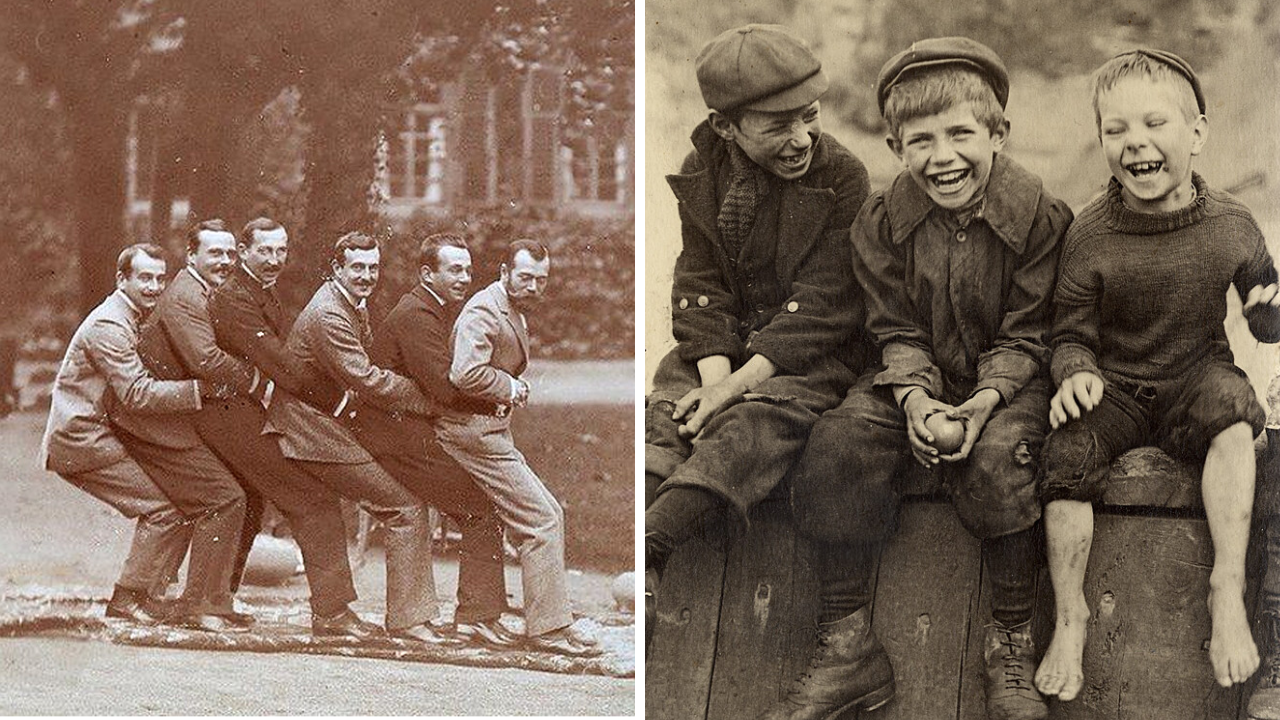
A playful photograph from 1899 shows Russia’s Nicholas II enjoying an informal moment with companions in Germany. Rather than the solemn stance expected of an emperor, the group appears happy to fool around for the camera. It is an unusual view of a ruler better known through ceremonies and official portraits.
Friends make a human chain in 1899

Several men crouch in a comic line outdoors while two women stand to the side, watching the scene. The group is often associated with informal gatherings around the Russian imperial circle in 1899. Their expressions and exaggerated arrangement make it look like a joke shared among friends rather than an official photograph.
An old photograph catches an unguarded joke

A group portrait preserves a playful moment instead of asking everyone to stand perfectly straight. Clothing and posing conventions may look unfamiliar now, but the impulse to make friends laugh has not changed. That contrast is one reason informal historical photographs can be so engaging.
A couple tries not to laugh for the camera

A vintage portrait shows a couple sharing an expression far removed from the standard unsmiling studio pose. Whether the photographer encouraged it or a private joke slipped through, the result feels unusually intimate. It is the kind of detail that turns an anonymous photograph into a story.
Frank Meadow Sutcliffe captures laughing boys

English photographer Frank Meadow Sutcliffe became known for scenes of everyday life around Whitby. His image of laughing boys preserves the energy of childhood instead of demanding a perfectly composed studio expression. It also reminds us that nineteenth-century photography could document ordinary people with affection and humor.
Charles Roscoe Savage photographs a smile

Photographer Charles Roscoe Savage made this portrait of a young woman with a gentle smile, dated broadly to the second half of the nineteenth century. Her ribbon and formal clothing follow the conventions of the carte de visite, a popular portrait format. The expression gives this carefully made image an unmistakably personal quality.
A Victorian woman’s smile takes center stage

In this vintage portrait, the sitter’s expression is the first thing a viewer notices. The setting and clothing retain the formality of nineteenth-century photography, but the smile breaks that convention. Small departures like this make early portraits feel less remote than expected.
A smiling nurse brightens a hospital portrait

A historical photograph from St. Bartholomew’s Hospital in London shows a smiling nurse carrying out her work. Hospital photography often documented buildings, equipment, or professional roles with a serious tone. Her expression introduces something just as meaningful: the personality of a caregiver.
A lace-capped woman smiles for the Holroyds

A portrait made by the Harrogate studio of Thomas and James Holroyd between 1863 and 1872 shows a woman wearing a lace cap and smiling toward the camera. Her clothing and pose are entirely conventional for the period. It is the warm expression that makes the image exceptional.
Skaters turn a winter scene into a social occasion

A historic view of a skating rink in Lafayette Park shows the pleasures of gathering outdoors in winter. The scene captures the kind of shared leisure that became increasingly visible as cameras documented public life. Even without a formal studio smile, the photograph belongs to the livelier world behind the nineteenth century’s serious reputation.
Victorians leave their serious faces at home

An informal outdoor group portrait finds its appeal in the sitters’ playful arrangement. It shows people treating the camera as part of the fun instead of merely a device for recording respectable appearances. Photographs like this preserve the social atmosphere that a stiff studio portrait can miss.
A young woman’s smile survives in a keepsake

A vintage portrait offers a glimpse of someone who chose a warmer expression than a rigid formal pose. Such photographs were often saved carefully, exchanged, or displayed as personal mementos. The smile gives the keepsake an immediacy that its unknown sitter might never have imagined.
A couple makes their portrait more personal

An old photograph of a couple captures the closeness that can be lost in stiff studio portraiture. Their arrangement makes the picture feel like a record of a relationship rather than simply two individual likenesses. It is an ordinary human detail that survives long after their names may have been forgotten.
Three gentlemen refuse to pose seriously

A playful photograph of three men replaces the standard sober portrait with humor. Their expressions and gestures suggest that the joke was part of the reason for making the picture. The image is proof that people were experimenting with comic poses long before the modern snapshot.
A French couple closes the gallery with a smile

This vintage French couple portrait presents a more relaxed view of nineteenth-century life. The pleasure of seeing two people interact matters more than the formal costume or studio setting. After so many supposedly stern old photographs, it is a fitting reminder that smiling for the camera was never an entirely modern invention.