Saturday matinees once turned neighborhood theaters into weekly gathering places filled with cartoons, serials, candy, and excited crowds. These vintage photographs revisit the ticket booths, glowing marquees, uniformed staff, packed auditoriums, and projection rooms that made the experience memorable. Each scene preserves a detail that disappeared as single-screen movie houses faded.
Five-cent tickets at the Pleasant Hour

The Pleasant Hour Theatre welcomed moviegoers beneath an arch covered with lightbulbs and hand-painted signs. A tiny booth offered five-cent tickets, making a few short films an affordable neighborhood outing.
The quiet auditorium at Wareham Hall

Rows of simple seats faced an ornate proscenium at Wareham Hall in 1908. The building added motion pictures during the early cinema boom, when an existing opera house could become the town's new screen destination.
A one-room movie house in West Virginia

Ben Shahn photographed a man outside this modest theater in Omar, West Virginia, in 1935. Hand-lettered boards advertised George O'Brien in Hard Rock Harrigan beside a building barely wider than its entrance.
North Park's all-talking attraction

The North Park Theatre in San Diego promoted Warner Oland in The Mysterious Dr. Fu Manchu beneath its towering vertical sign. The words “all talking” still carried real excitement as sound pictures transformed neighborhood programs.
Jean Harlow lights up the Keith-Albee

Cars line the curb beneath the Keith-Albee Theatre marquee in Huntington, West Virginia, in 1935. Jean Harlow and William Powell's names dominate the promotion for Reckless, turning the facade into a giant newspaper advertisement.
The Liberty Theatre on a dusty main street

The Liberty Theatre sign rises above parked cars and storefront awnings in Pagosa Springs, Colorado. Its marquee advertises the 1938 film The Duke of West Point, placing Hollywood entertainment in the middle of a quiet small-town block.
A glowing theater on a foggy night

Jack Delano photographed this Greensboro, Georgia, movie house at night in 1941. Fog softens the surrounding building while the bulbs announcing Law and Order and Sleepers West make the entrance shine.
Friday night outside Chicago's Regal

The Regal Theater marquee spilled light across the sidewalk on Chicago's South Side in 1941. Patrons clustered around the entrance beneath film titles and showtime lettering that could be read from across the street.
The crowd pours down the Regal staircase

Well-dressed moviegoers descend the Regal Theater's grand staircase after a show. Draped curtains, carved columns, and promotional displays reveal how a neighborhood cinema could feel like a palace.
Ten-cent tickets at the Easter matinee

Families crowd around an ornate Chicago ticket booth during an Easter Sunday matinee in 1941. Posted prices and movie posters surround the cashier while children wait for their turn at the window.
A parade outside the Ioka Theatre

The Ioka Theatre in Exeter, New Hampshire, drew a festive crowd beneath flags and bunting in 1941. A small parade passes the parked cars while the marquee promotes a March of Time newsreel and the next feature.
Lucky Night gets a lobby spectacle

A large caricature display for the 1939 film Lucky Night fills this theater lobby. Matching attendants pose around Myrna Loy and Robert Taylor's names, showing how promotion continued after patrons stepped inside.
Buying tickets beneath rows of bulbs

A woman speaks to the cashier while a man waits beside the glass booth in this 1940 scene. Bright ceiling bulbs and a nearby display of film stills made the box-office stop feel like part of the show.
Usherettes waiting for the premiere crowd

Robert Frank photographed four usherettes at a Hollywood movie premiere in 1956. Their matching white uniforms stand out against the dark curtains and flags as they wait for the lobby to fill.
Every seat filled in Des Moines

The Paramount Theater in Des Moines appears packed from the main floor to the balcony in this 1940 photograph. A high camera angle captures the scale of a screening before television changed weekend habits.
Faces turned toward one shared screen

Hundreds of patrons sit shoulder to shoulder in this 1940s auditorium. Their formal clothes and close rows show how a movie could turn an ordinary afternoon into a large communal event.
An early auditorium before the crowd

Upholstered seats face a curtained screen in this early twentieth-century auditorium. With the room empty, the shallow stage, paneled walls, and narrow aisles become the main attraction.
John Wayne on the GEM marquee

The GEM Theatre used every inch of its 1954 marquee to advertise John Wayne and John Agar in Sands of Iwo Jima. Posters flanking the doors gave passersby one more look before they bought a ticket.
A Disney program at the Capitol

The Capitol Theater in Salem glows around a Disney program from the early 1950s. Story of Robin Hood, Water Birds, and Little House share the marquee, recalling the mixed programs common at family matinees.
Two features at Nebraska's Fort Theatre

The Fort Theatre anchors this Nebraska corner with a vertical sign and a two-title marquee in 1945. Parked cars, a newspaper box, and one passing pedestrian place the cinema firmly inside everyday downtown life.
Thirty-five-cent seats at the Markay

The Markay Theatre promoted James Whitmore in Shadow in the Sky beside an adult admission price of 35 cents. A station wagon and neighboring drugstore complete the early-1950s street scene.
Popcorn handed across the Paramount counter

A Paramount Theatre attendant hands a tall cup of popcorn to a young customer in 1954. Candy bars fill the glass case behind them, while balloons and a striped awning make the lobby stand feel festive.
The Sweet Shoppe sold more than popcorn

Uniformed attendants stand behind a Sweet Shoppe counter packed with boxed candy. Large Necco advertisements and a 20-cent Butter Cups sign show how prominently branded treats competed for attention.
A concession case ready for intermission

One attendant waits behind a curved display case filled with candy and popcorn. Lightbulbs frame the stand, turning a practical snack counter into another bright attraction inside the theater.
The projectionist behind the wall

Marion S. Trikosko photographed a projectionist adjusting a large machine in 1958. Through the small booth window, two patrons are visible in the auditorium while the operator keeps the picture running.
The machinery behind a 1939 screening

Large projectors crowd a narrow booth in this 1939 theater photograph. Film cans, vents, switches, and heavy housings reveal the equipment hidden behind a smooth show on the screen.
Two operators keep the reels moving

Two operators work beside an open projector mechanism in this mid-century booth. Their hands-on attention shows how every reel depended on trained staff watching the machine throughout the program.
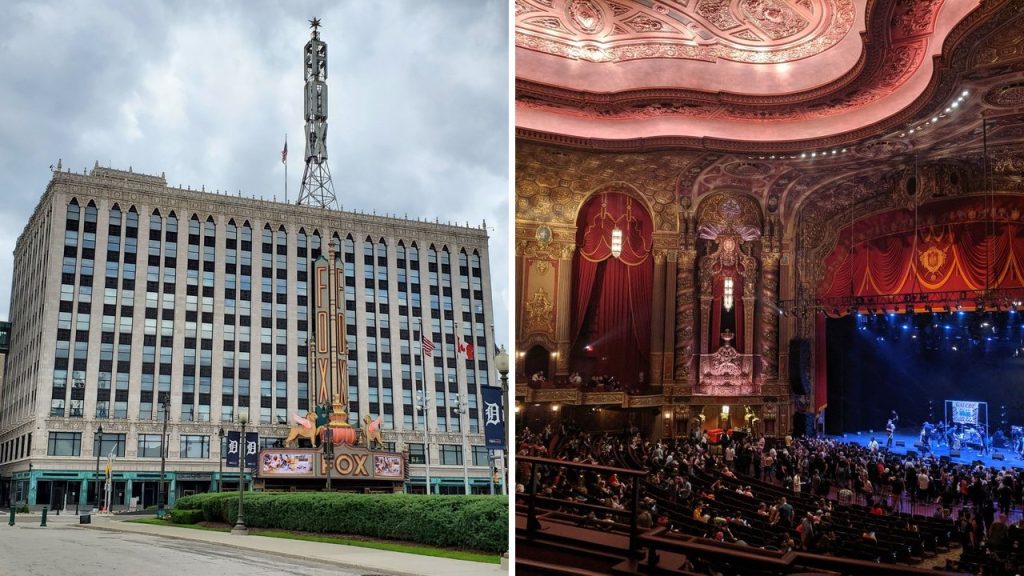
The Riviera's grand lobby in 1970

Allen Stross documented the Grand Riviera Theatre's ticket counters and carved arches in 1970. The empty lobby still carried the lavish 1920s design that had greeted generations of Detroit moviegoers.
The Roxy usherettes' white-glove inspection

Head usherette Rosemary Smith inspects a line of uniformed staff members at New York's Roxy Theatre in 1945. Matching coats, gloves, belts, and shoes reflect the formality once expected from movie-palace employees.
The Easter matinee line in Bronzeville

Edwin Rosskam photographed children waiting outside a Chicago theater on Easter Sunday in 1941. Coats, hats, film posters, and the patient line capture the anticipation of a special neighborhood matinee.