Before sneakers became collectibles, shoes were already doing improbable things. Ancient sandals could be woven from reeds, eighteenth-century heels could announce status, and some bathhouse platforms looked more like tiny furniture than footwear. These 30 surviving pairs show how much ingenuity, identity, and occasional impracticality people put into what went on their feet.
The wedding shoes embroidered right down to the heels

In the late Ottoman Empire, even a bride’s shoe heels could disappear beneath metallic embroidery. This pair of ankle shoes was probably made to accompany a bindalli wedding dress, whose floral design also covered the garment. The Met notes that shaped gold and silver threads gave the velvet surface a sculptural effect, while elastic side panels reveal a European influence on the construction.
Ceremonial shoes that look nothing like sneakers

These early nineteenth-century priest’s shoes, attributed to China or Tibet, were made from pigskin and silk. The Met records their unusual length at fifteen inches, making the silhouette a striking part of the object. Their ritual association, not a modern runway, supplies the context for this unfamiliar shape.
The tiny silk shoes made in China

A pair of Chinese shoes in the Met’s collection measures about five inches long, with one photographed from the front and the other from the side. The silk-and-cotton objects are dated broadly between 1800 and 1943, so a more precise year would be guesswork. Their proportions and construction make a powerful illustration of how different historic footwear could look.
Papyrus sandals older than the Roman Empire

This remarkably well-preserved Egyptian pair was woven from papyrus reeds roughly between 1580 and 1479 BCE. Both shoes survive, and the Met lists slightly different measurements for the left and right soles. Long before molded rubber flip-flops, plant fibers could become carefully shaped footwear.
A small pair of leather sandals from ancient Thebes

These leather sandals date to the joint reign of Hatshepsut and Thutmose III, about 1473 to 1458 BCE. They were found in the Theban area during excavations in the 1930s and measure only about five and a third inches long. That combination of precise archaeological context and an unusually small surviving pair gives this entry its interest.
Palm-leaf sandals for a very small wearer

A pair of infant sandals from Byzantine Egypt was woven from palm leaves sometime between the fourth and seventh centuries. Their construction included woven soles and plaited straps, with pointed toes rather than the square-toed forms known from some related finds. The details show that even a child’s most basic footwear could require considerable handiwork.
The sandals meant for an Egyptian burial

Not every surviving pair of sandals was simply everyday streetwear. The Met identifies these dyed palm-leaf examples as funerary sandals, probably dating to the first century CE. Their archaeological setting at Deir el-Bahri tells us more about their recorded role than speculation about how comfortable they might have been.
Moccasins covered in tiny flowers and zigzags

These Muscogee or Creek moccasins, dating to around 1830, were made from dyed hide and decorated with floral and zigzag patterns in tiny beads. The Met explains that their silk lining could show at the ankle, adding a flash of luxury to an otherwise practical form. Their likely special-occasion use makes the pair more than an example of everyday footwear.
The beaded moccasins with metal cones

Around 1890, makers from the Sioux peoples produced this pair using leather, glass beads, and metal cones. The museum records each shoe at about ten inches long. Their densely worked surfaces challenge the assumption that intricately decorated shoes were only a European fashion tradition.
Baroque shoes that almost needed jewelry insurance

This pair, probably British and dating between 1690 and 1729, combined sharply pointed toes with elaborate three-dimensional metallic embroidery. The Met notes that a large buckle, potentially jewel-set, would have added still more ornament. Even the relatively stocky heel seems restrained next to all that decoration.
When shoe tongues flared out like collars

Fashionable British shoes around 1700 to 1739 could have pinched toes, high throats, and striking flared tongues. This pair also carries rows of braid and retains fragments of its original ties. Those surviving ties matter because decorative buckles had not yet fully displaced that closure style.
Velvet, metallic ribbons, and red heels

A British pair dated 1732 to 1759 combines richly patterned velvet with broad metallic trim and red heels. The Met notes that red heels and a white strip at the sole were familiar period details, but together they produce an especially bold look. A modern viewer might mistake the flamboyance for costume design; these were genuine fashionable shoes.
Yes, eighteenth-century men wore red heels

These light-colored British men’s shoes from 1740 to 1779 carry unmistakable red heels. The Met connects that feature to aristocratic French court fashion and notes that the pair later belonged to two Scottish painters. In a period often imagined as uniformly restrained for menswear, the shoes offer a useful correction.
Court shoes rebuilt to hold flashy buckles

This French men’s pair from about 1780 to 1800 shows fashion literally being retrofitted. The shoes originally followed a tie-closure style, but straps were added so they could accommodate the buckles still associated with court dress. The red heels were another aristocratic detail lingering from earlier fashions.
A strip of metallic lace down the front

These probably British shoes, dated 1730 to 1755, put a broad band of metallic lace along the front. Their stepped side seams also track a change in construction as straps widened to support bigger buckles. Details that seem excessive today were clues to quality and fashion in the eighteenth century.
Gold-trimmed shoes designed to peek out from gowns

From 1720 to 1739, this European pair used silk, gold, and leather to make a visual statement in miniature. The Met explains that long gowns exposed only small portions of a woman’s shoes, making the decorated front especially important. The curved Louis heel provided a fashionable flourish even when most of the shoe stayed hidden.
The iron-ring shoes worn over delicate shoes

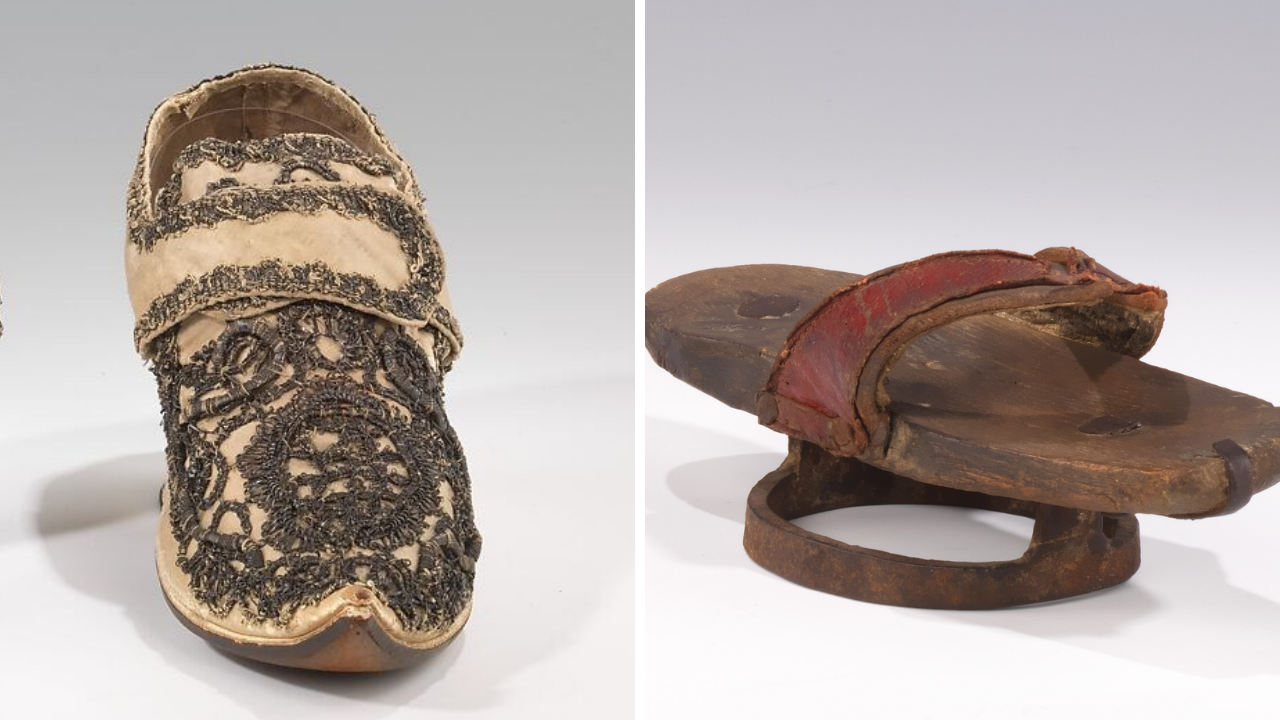
Eighteenth-century wearers sometimes protected fine silk footwear with pattens: wooden oversoles raised above the ground by an iron ring. This European pair shows that practical solution in unusually visible form. What looks like a strange piece of industrial hardware was meant to keep expensive shoes away from mud and dirty streets.
Even children wore these little shoe stilts

This rare British child-sized pair of pattens dates to 1830 to 1850. A wooden platform sat above an iron ring, separating a child’s delicate shoes from wet or dirty streets. By the 1850s, the Met notes, vulcanized rubber galoshes helped push this awkward-looking solution out of fashion.
Winter overshoes with serrated metal underneath

Late eighteenth-century American pattens could be built for more than rain. This pair combines leather pads studded with hobnails and a serrated iron ring, leading the Met to suggest use on icy streets. They resemble a distant ancestor of winter traction gear, only with an extra platform between foot and pavement.
Thirty-centimeter bathhouse platforms

These nineteenth-century hammam shoes from Turkey are twelve inches tall, according to the Met’s measurements. Their wooden supports carry geometric mother-of-pearl inlay and silver ornament, turning a bathhouse accessory into a display of extraordinary workmanship. With their flared supports and dangling details, they look more like miniature furniture than conventional shoes.
The bright red shoes made for eighteenth-century children

Children’s shoes did not have to be plain, even in the late eighteenth century. This bright red European pair borrows the pointed toe and tongue of fashionable adult footwear but adds flat heels more suitable for a child. The Met notes that examples made for older children rarely survive in such good condition.
Walking boots decorated far beyond necessity

Most nineteenth-century walking boots were fairly restrained, which makes this American pair from 1865 to 1875 remarkable. Machine embroidery covers the uppers, and additional beaded cordwork appears to have been added later, possibly by the wearer. The result looks closer to party footwear than the sturdy button boots it started as.
Children’s shoes that were never meant for children

At first glance, these European shoes from around 1860 look like ornate children’s footwear. The Met instead believes their extraordinarily detailed impressed leather patterns identify them as a craftsman’s display sample, made to show off advanced skill. That makes their impracticality the whole point, rather than a design failure.
Pink slippers from a Chinese maker for Western customers

These satin evening slippers were made around 1855 to 1865 by a business identified on the original label as Hing Sheng Boot and Shoe Maker. Their style follows Western fashion, even though the Met suggests the maker may have worked in a Chinese trading center serving Western customers. A surviving label turns a pretty pair of shoes into a story about global commerce and craftsmanship.
Parisian evening shoes with three-dimensional ribbonwork

The owner of these French shoes traveled to Paris for fashionable clothing in the late nineteenth century. Their embroidered ribbon decoration, which the Met describes as unusually three-dimensional, made them stand apart even in the world of luxury evening wear. The ankle ties were fashionable around 1880 but never as common as simpler pumps.
Beaded boots from the turn of the century

This pair of leather-and-bead boots dates to around 1900, with the Met cautiously identifying its origin as American or European. Rather than inventing a designer, the surviving materials supply the story. The striking embellishment is a reminder that unusual boots existed long before fashion houses turned dramatic footwear into headline news.
Baby shoes in a surprisingly bold pink

These American infant shoes date to 1832 or 1833 and combine deep pink with brown leather. The Met explains that strong colors were not unusual for babies then, despite today’s association of infants with pale pastels. A family history even links the shoes to a portrait of a female ancestor, offering a rare personal thread behind a tiny surviving pair.
Venetian platforms with tassels under the toes

This Italian pair from about 1550 to 1650 turns platform footwear into a small feat of architecture. Green velvet, gold braid, hobnails, and dangling tassels decorate the raised lobed soles. The Met suggests that such unusual chopines survived in disproportionate numbers precisely because later owners found them too remarkable to discard.
Gold leather oxfords decades ahead of the trend

Around 1891, the New York retailer Alfred J. Cammeyer sold these astonishing gold kid-leather oxfords. The Met observes that full lacing normally belonged to daywear while metallic leather did not become widespread in evening shoes until the 1920s. Their look was so unusual for their time that even the museum wonders what occasion called for them.
The Venetian platforms that made walking an event

At around 1600, fashionable Venetian women could wear chopines that lifted their feet dramatically above the pavement. The Met explains that the height helped protect shoes from damp streets while also signaling social position. Both wealthy patrician women and courtesans wore the style, so a towering platform alone does not tell us the wearer’s identity.