Before computerized rides and carefully themed attractions, amusement parks were already finding outrageous ways to thrill their visitors. From looping roller coasters and spinning floors to enormous wooden structures that seem almost unbelievable today, these old photographs capture an era of fearless experimentation. Take a look at 30 unforgettable scenes from amusement parks that turned a day of fun into something extraordinary.
The Flip Flap Railway’s terrifying loop

The Flip Flap Railway at Coney Island sent passengers through a complete vertical loop at the turn of the twentieth century. Unlike the carefully engineered loops of modern roller coasters, its tight circular curve subjected riders to punishing forces. The attraction became notorious for its uncomfortable ride, and spectators reportedly enjoyed watching it almost as much as people enjoyed riding it. Looking at the structure today, it is easy to understand the fascination.
Coney Island’s other impossible-looking loop

Coney Island’s Loop the Loop opened in 1901 and offered another dramatic variation on the looping roller coaster. Its elongated loop was an attempt to make the experience more manageable than the brutal circular designs that had come before. The photograph from 1906 captures a period when amusement park engineers were still experimenting with what a roller coaster could safely accomplish.
The Tickler gave riders a rough surprise

The Tickler was one of the wonderfully strange attractions associated with early Coney Island. Instead of offering the predictable movement of a conventional railway car, the ride sent passengers through a twisting course designed to make their journey unpredictable. Its unusual machinery belonged to an era when simply getting shaken around could count as a major attraction. The name was playful, but the experience was anything but gentle.
A tiny railroad at Coney Island

Not every unusual amusement park attraction depended on frightening heights or sudden drops. The Cagney Miniature Railway recreated the experience of railroad travel on a scale intended for entertainment. Its small locomotive and passenger cars brought the excitement of steam technology into the amusement park. For children, boarding a miniature train could feel like setting off on a real journey.
The Fairy Whip sent cars swinging around

The Fairy Whip offered another example of Coney Island’s fascination with mechanical motion. The attraction used a compact track and turning movements to give riders the sensation of being pulled sharply around its course. It was an early expression of a ride concept that would become familiar at amusement parks across America. The original setting looks remarkably simple compared with the elaborate attractions that followed.
Drop the Dip promised a wild descent

The Drop the Dip roller coaster was part of the crowded entertainment landscape around Coney Island’s Bowery. Its name made the selling point perfectly clear: visitors could expect sudden changes in elevation and an exhilarating descent. Early wooden coasters often relied on dramatic silhouettes and imposing structures to attract customers. Even from the street, the ride was designed to command attention.
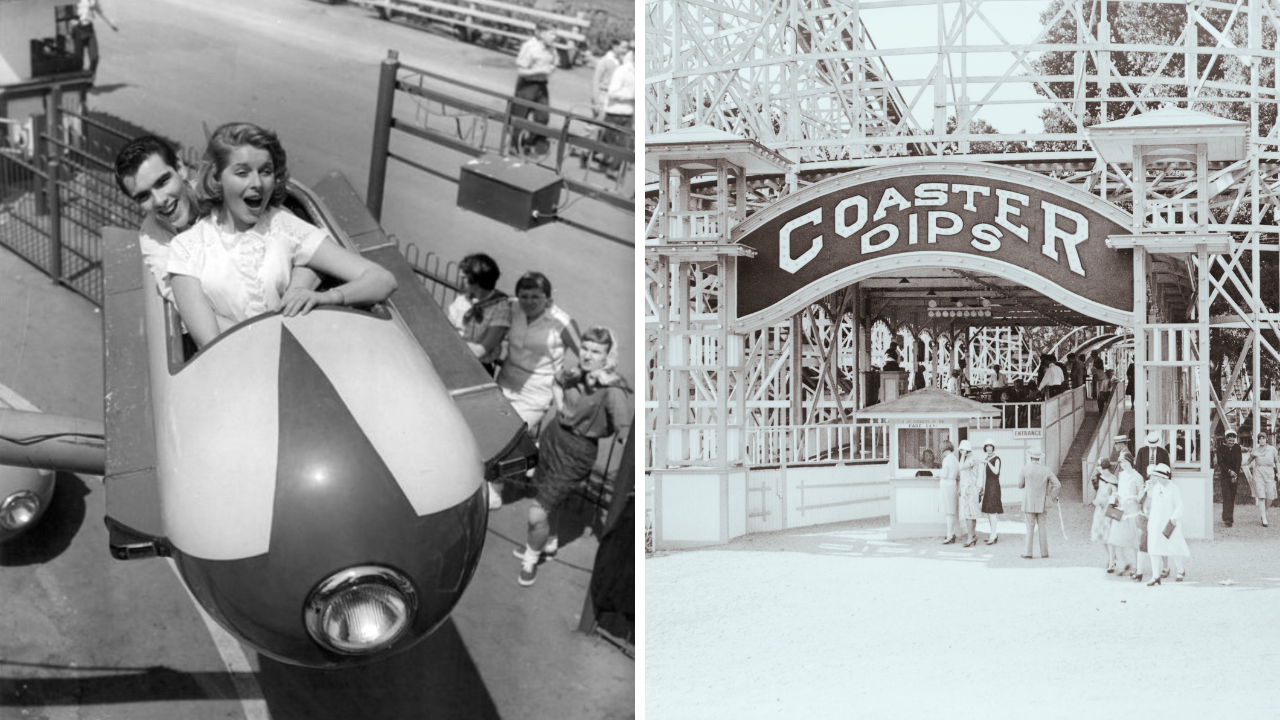
The Coaster Dips at Glen Echo Park

The entrance to the Coaster Dips at Glen Echo Park in Maryland offered visitors a glimpse of the excitement waiting beyond the gates. Roller coasters became major attractions at the park during the early twentieth century, when elaborate wooden structures defined the amusement experience. The historical photograph preserves a moment when even approaching the ride was part of the thrill.
Waiting in line for a wooden roller coaster

An amusement park photograph from the 1940s captures visitors waiting for their turn on a roller coaster. The scene feels familiar, even though the clothing and surroundings belong to another generation. Long lines have always been part of the experience when a popular ride promises a few unforgettable seconds of excitement. The anticipation was almost an attraction of its own.
Seattle’s Luna Park by the water

Seattle’s Luna Park opened along the waterfront in West Seattle, giving visitors a combination of amusement rides and seaside recreation. This photograph from around 1909 captures a destination where a roller coaster, carousel, and other attractions stood close to the water. The park offered an escape from ordinary city life, complete with the spectacle of mechanical rides overlooking Elliott Bay.
A roller coaster overlooking Elliott Bay

The roller coaster at Seattle’s Luna Park occupied a remarkable setting beside the waterfront. Wooden tracks and supporting beams created a dense framework that must have looked impressive against the surrounding shoreline. In an age before enormous steel roller coasters became commonplace, attractions like this delivered the excitement of speed through relatively simple mechanical designs.
Dorney Park’s wooden giant in 1932

A postcard from 1932 shows the towering wooden roller coaster at Dorney Park in Allentown, Pennsylvania. The structure was a maze of timber supports and sweeping tracks, the kind of construction that made early amusement parks visually unforgettable. Wooden roller coasters combined speed with the unmistakable sound and movement of trains traveling over their tracks. Their engineering became part of the spectacle.
A train winding along Cedar Creek

A 1920 view of Dorney Park shows a train traveling along Cedar Creek, revealing a quieter side of the amusement park experience. Scenic railway journeys offered visitors a chance to enjoy the surroundings without the intensity of a roller coaster. The combination of natural landscapes and mechanical entertainment helped make early parks appealing to entire families.
Olentangy Park’s enormous water slide

Olentangy Park in Columbus, Ohio, introduced a Shoot-the-Chutes attraction in 1909. The concept was straightforward but spectacular: boats traveled down a steep incline and splashed into a pool below. Watching the landing could be nearly as entertaining as taking the ride. The imposing structure shows how amusement parks turned ordinary elements such as water and gravity into major spectacles.
The Derby Racer at Revere Beach

Revere Beach in Massachusetts became famous for its seaside amusement attractions, including the Derby Racer. Racing roller coasters offered an additional source of excitement by placing trains on neighboring routes. The appeal was not simply the drops and turns, but the possibility of watching another group of riders traveling alongside you. These elaborate structures gave the beachfront a skyline unlike any ordinary resort.
Crystal Beach looked like another world

An aerial view of Crystal Beach in Ontario reveals the impressive scale of an amusement destination along Lake Erie. From above, the crowded collection of buildings and attractions looks almost like a small city devoted entirely to entertainment. The photograph also shows how important waterfront settings were to the development of amusement parks. Visitors could combine mechanical thrills with the pleasures of a lakeside vacation.
The causeway at Euclid Beach Park

Euclid Beach Park was one of Cleveland’s best-known amusement destinations, attracting generations of visitors to the Lake Erie shoreline. Its causeway and surrounding attractions created a setting where a day at the park felt like a departure from everyday life. The photograph preserves the architectural character of an entertainment complex that became part of the city’s collective memory.
Dancing beside a massive roller coaster

A historical image of Euclid Beach Park shows a dance hall alongside a roller coaster, two attractions that represented different kinds of excitement. Visitors could spend part of the evening dancing before heading outside to enjoy the rides. The combination reflects how early amusement parks functioned as social destinations, not merely collections of mechanical attractions.
Cedar Point’s fantastical Crystal Rock Castle

Cedar Point in Sandusky, Ohio, once featured the striking Crystal Rock Castle, an attraction whose appearance seemed borrowed from a fantasy illustration. Elaborate decorative architecture helped amusement parks transform familiar spaces into imaginary worlds. Buildings like this offered a visual spectacle even to visitors who were not interested in riding a roller coaster. Its unusual form feels very different from the sleek themed attractions of today.
A carousel beside the Circle Swing

Chicago’s Riverview Park combined familiar family attractions with machines that looked increasingly ambitious. A historical view showing a carousel and the Circle Swing demonstrates how different rides could compete for attention within the same space. The towering swing structure offered a dramatic contrast to the decorative elegance of the carousel. Together, they captured the variety that made the park such a popular destination.
The Scenic Railway at Riverview Park

A 1908 image of Riverview Park’s Scenic Railway shows an early approach to roller coaster entertainment. Before the dramatic steel tracks of later decades, these attractions used wooden construction and carefully arranged routes to create excitement. The ride offered a combination of motion, scenery, and mechanical novelty. What looks modest today represented a major attraction for its original audience.
Chicago’s spectacular Shoot the Chutes

Riverview Park’s Shoot the Chutes brought a dramatic water-based attraction to Chicago. Riders traveled along an elevated course before plunging into the water, creating a splash that spectators could watch from nearby. The attraction depended on a simple formula: height, speed, and an unforgettable landing. It helped demonstrate that a ride did not need complicated machinery to deliver a memorable thrill.
The eerie entrance to Hell Gate

Hell Gate at Chicago’s Riverview Park promised a very different kind of amusement. Rather than focusing entirely on speed or height, the attraction used theatrical scenery and an ominous name to build suspense. Dark rides and similar attractions invited visitors into imagined worlds filled with surprises. Even the historical imagery suggests that creating an unsettling atmosphere was part of the appeal.
The mysterious Mill on the Floss

The Mill on the Floss at Riverview Park belonged to a tradition of attractions that mixed storytelling, scenery, and controlled movement. A photograph from 1942 preserves an environment designed to transport visitors into a miniature theatrical world. Rides of this kind offered an alternative to the sheer speed of roller coasters. Their charm came from the unexpected scenes waiting along the route.
The Merry Widow’s unusual spinning ride

The Merry Widow was another example of the inventive ride designs that appeared in American amusement parks. Its distinctive mechanical structure made it stand out among more familiar attractions. Early park operators continuously experimented with new ways to move passengers, whether through spinning, swinging, or carefully controlled changes in direction. The result was often a machine that looked as entertaining as the experience itself.
The Jet Rocket brings the space age to Chicago

A 1957 photograph of the Jet Rocket at Riverview Park captures an era when space-age imagery was becoming part of American entertainment. The attraction’s futuristic name reflected the excitement surrounding rockets and new technologies. Amusement parks frequently borrowed ideas from popular culture, turning the public’s fascination with science and exploration into experiences that families could enjoy.
The Whip throws riders around the turns

The Whip at Riverview Park offered a deceptively simple mechanical thrill. Cars followed an oval course and swung sharply around the ends, creating a sudden sensation of speed and changing direction. A photograph from 1957 shows how this familiar amusement ride remained popular long after its introduction. It was proof that a relatively compact attraction could still deliver plenty of excitement.
Vancouver’s gravity-defying spinning ride

A photograph from the 1950s shows the Centrifugal Force Ride at Playland in Vancouver. Instead of depending on enormous drops, the attraction used rapid rotation to create a dramatic physical sensation. Riders experienced forces that made the spinning machine feel far more intense than its simple appearance suggested. The image captures the midcentury fascination with mechanical thrills.
Venice Beach packed with amusement seekers

A historical view of the Venice Beach amusement district in California captures the crowds that gathered along the oceanfront in the early twentieth century. Visitors came for the rides, entertainment, and atmosphere of a destination that mixed the beach with an extraordinary variety of attractions. The photograph shows how amusement districts could become entire social worlds, filled with movement and spectacle.
The Human Roulette Wheel sends riders flying

At Coney Island’s Steeplechase Park in 1908, visitors climbed onto an enormous rotating platform known as the Human Roulette Wheel. As it spun, people struggled to remain seated while the motion sent them sliding toward the edges. The attraction transformed a simple circular floor into a spectacle of tumbling passengers and delighted spectators. It remains one of the most astonishing images of early American amusement park culture.
The Bobs towers over Riverview Park

Chicago’s Riverview Park was home to the Bobs, a wooden roller coaster celebrated for its formidable structure and thrilling ride. The historical postcard captures the dense framework of timber that supported its dramatic track. Before computer-designed steel coasters became familiar, attractions like the Bobs relied on elaborate wooden engineering to deliver their excitement. Its imposing silhouette makes a fitting conclusion to this look at amusement parks of another era.